


Full Quran Audio MP3 Offline
AppSoNix
Full Quran Audio MP3 Offline is the kind of app I would recommend to someone who wants the Quran close at hand without depending on a constant internet connection. In my experience, its main appeal is straightforward: it brings reading, listening, and personal reflection together in one mobile tool rather than making me switch between a browser, a music player, and a separate Quran reader. That focused purpose makes it more useful than its simple store summary might suggest.
Developed by AppSoNix, this free app sits in the Libraries & Demo category and is aimed at Everyone. It has reached over a million installs and holds a 4.6 average from around eleven thousand ratings, which gives it a reassuring level of public use. I would not treat popularity as proof that every user will enjoy it, but it does suggest that the basic idea works for a broad audience.
My overall view is that Full Quran Audio MP3 Offline is strongest as a dependable listening companion, not as a complete replacement for every specialized Quran study tool. If your priority is having Quran audio available during a commute, quiet evening, or offline period, it makes a convincing case. If you need advanced scholarly references, highly detailed study notes, or a carefully tailored memorization system, you may eventually want something more specialized alongside it.
What makes the app useful in everyday use
The first thing I noticed is how naturally the app fits short, repeatable routines. I can open it when I have a few minutes, read at my own pace, or shift into listening when my attention is occupied. That flexibility matters because Quran use is not always the same from one moment to the next. Sometimes I want to follow the text closely; at other times, audio is the practical option.
The offline focus is especially valuable. Many Quran applications assume that users will always have a stable connection, but that is not realistic for flights, rural areas, underground travel, limited data plans, or simply moments when I want to avoid distractions. With an offline audio workflow, the app can become part of a daily routine instead of something I use only when the network cooperates.
Related News

Instagram Is No Longer a Photo App. It Is an Attention Engine

Microsoft Teams Mobile: When Collaboration Becomes Navigation

How the NFL App Adapts to Android and iOS Updates

Temu: Elevate Your Shopping Experience to Billionaire Status

Why Traffic Rider Works Best as a Precision Reflex Game

How Google’s Find Hub Transforms Everyday Searches
A realistic example is a morning commute. I can prepare the listening material before leaving, then use the journey for quiet reflection without opening a social media app or searching through a website. On a different day, I might read during a break and listen later at home. That change between reading and audio is more useful than having only one presentation style.
The app’s broad purpose also makes it approachable for family use. A person who is already comfortable reading digital Quran text can use the audio as an additional aid, while someone who is still building a regular listening habit can start with short sessions. Since the content rating is Everyone, it is positioned as a general-purpose religious resource rather than an app designed for a narrow age group.
One practical tip is to treat offline audio as a planned resource rather than something to test for the first time when you urgently need it. I would open the app while connected, explore the available listening options, and make sure the material I expect to use is ready. That small habit avoids frustration later and makes the offline promise more meaningful in real life.
Gallery
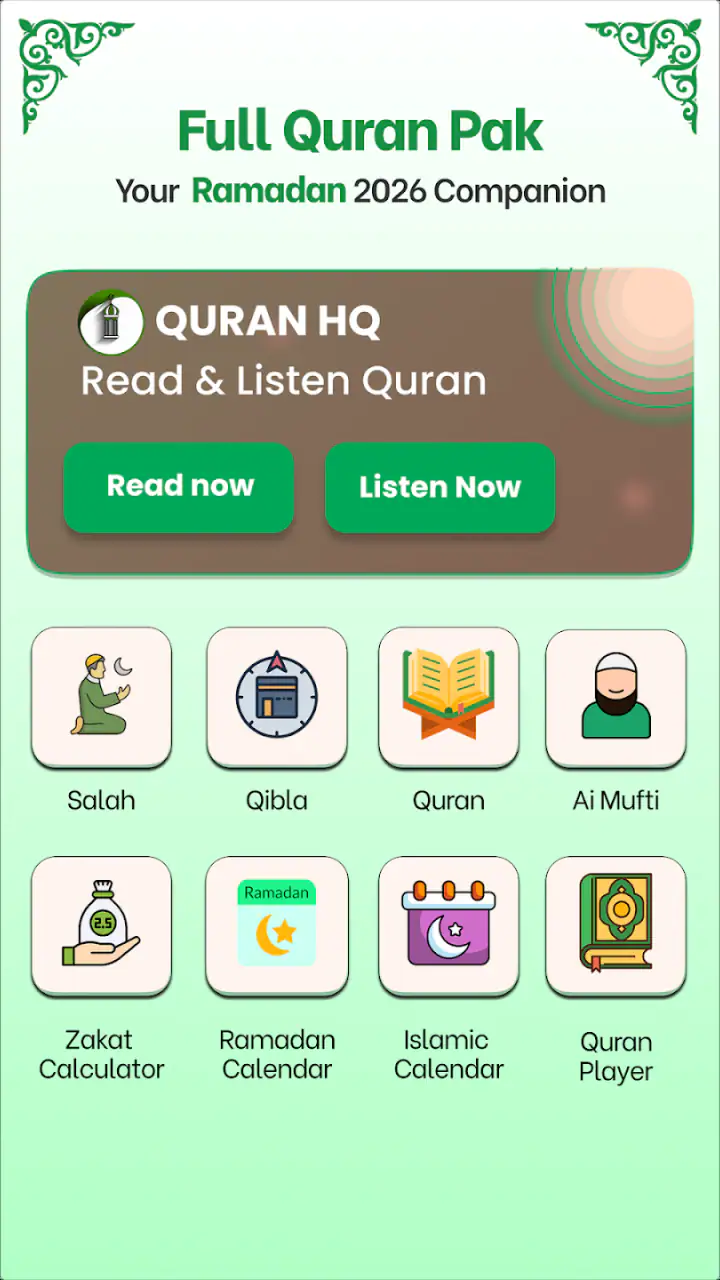
Reading and listening serve different purposes
I like that the app is not limited to audio alone. Listening is excellent when my hands and eyes are occupied, but reading gives me a more deliberate way to slow down. Moving between the two can support different goals: audio for continuity and repetition, reading for closer attention, and a combination of both when I want to reinforce familiarity.
This is also where the app can help someone developing a consistent habit. Instead of setting an unrealistic target that requires a long uninterrupted session, I can use a short listening period while walking and then read a smaller passage later. The value comes from making the practice easier to repeat, not from turning it into a race through the content.
A useful workflow for learners is to listen first without trying to follow every detail, then return to the same passage with the text visible. That approach can make the audio feel less passive. It encourages me to notice pronunciation, rhythm, and passages that deserve a slower reading. I would still use a teacher or trusted educational resource for formal correction, but the app can support the repetition between lessons.
Another non-obvious advantage is that offline listening reduces the temptation to multitask online. A web-based alternative may offer more surrounding information, but it can also place search bars, recommendations, notifications, and unrelated tabs within reach. This app’s narrower purpose can be a strength when I want a quieter session.
Where it compares well with common alternatives
The usual alternative is a browser-based Quran site. Websites can be excellent for quick access and may offer broader reference material, but they depend more heavily on connectivity and often require extra steps before listening. Full Quran Audio MP3 Offline is better suited to repeated access in the same places, especially when I do not want to reload pages or use mobile data.
Another alternative is a general music or audio player containing downloaded files. That approach may offer familiar playback controls, but it separates the audio from the Quran reading experience. I would then need another app to follow the text, and switching between tools can make a reflective session feel unnecessarily technical. The dedicated format here is more coherent for users who want both modes together.
Some larger Quran platforms may be a better choice for people seeking extensive translations, tafsir, bookmarking systems, recitation comparisons, or structured study features. I would choose one of those if research and customization were my main goals. The advantage of this app is not that it does everything; it is that its central task is easy to understand and convenient to repeat.
That distinction is important. A smaller, focused tool can feel faster and less intimidating, while a feature-heavy alternative may reward users who are willing to spend time configuring it. I see Full Quran Audio MP3 Offline as the more practical choice for listening and reading on ordinary days, rather than the definitive option for advanced study.
The offline workflow deserves a little planning
Offline use is the feature I would investigate first after installation. I would not assume that every part of the experience behaves identically without a connection. Instead, I would test the exact passages or audio I plan to use, then repeat that test with connectivity disabled. This is a simple but important habit for any app whose main attraction is offline access.
That testing also helps me understand storage and device behavior in a practical way. Audio can take up more room than text, so I would avoid downloading material blindly if my phone has limited space. A focused selection is often more convenient than trying to keep every possible option available. The best offline library is the one I can find quickly and use without hesitation.
For travel, I would prepare before leaving rather than during boarding or while already in transit. For daily use, I would keep the app in a predictable place on the phone and use a small routine: open it, choose the intended passage, listen without unnecessary interruptions, and return to reading when I have visual attention available. These details sound minor, but they are what turn a download into a dependable habit.
Users should also remember that offline audio is not the same as unlimited flexibility. If the app requires particular content to be prepared in advance, spontaneous access to something new may be less convenient than using an online service. That is the central trade-off: better independence from the network, but more responsibility to organize the material beforehand.
Where the experience falls short
My main reservation is that the app’s focused design may feel limited to users who expect a full study environment. Listening and reading are valuable, but serious learners may want more context around the text, more ways to compare interpretations, or tools that guide a long-term memorization plan. I would not download this expecting it to replace a teacher, a reference library, or a dedicated academic resource.
The offline emphasis can also create friction if I forget to prepare. A user who normally relies on streaming may expect to tap any passage immediately, only to discover that offline readiness requires some forethought. That is not a flaw in the purpose of the app, but it does affect convenience. The experience rewards planning more than spontaneity.
There is another trade-off between simplicity and control. A focused app can be easier to approach, yet users who want highly personalized playback or a large collection of study settings may find the available experience less satisfying than a more advanced alternative. I would be cautious about choosing it solely because it is free if I already know that customization is important to me.
The free price is a strong reason to try it, though in-app purchases ranging from $1.99 to $10.99 per item mean that the experience may include optional paid elements. I would review any purchase prompt carefully and decide whether it adds value to my particular routine. The free starting point makes experimentation easy, but it is still sensible to understand what is included before paying for extras.
The current version is 5.3, and the app supports Android 7.0 or later. That gives it a useful compatibility range for many existing phones, although anyone using an older device should check the operating system before planning around it. I also prefer testing an app on the actual phone I intend to use, because audio storage, battery behavior, and screen comfort can vary considerably between devices.
Who will get the most from it
I think the best audience is someone who wants a simple Quran companion for regular listening and reading, especially someone who values access away from Wi-Fi. It suits commuters, travelers, people with inconsistent mobile coverage, and users who prefer a dedicated religious app over a browser full of distractions.
It can also work well for someone beginning an audio habit. The app does not require that every session be long or formal. A person can listen during a quiet walk, read before bed, or use repeated passages as part of personal practice. The important point is to choose a sustainable routine rather than treating the app as something used only on special occasions.
Families may appreciate its general age positioning, while older phones that meet the minimum operating system requirement can remain useful for this purpose. That makes it a reasonable option when the newest, most demanding applications are not desirable. I would still consider screen size and speaker quality, since those affect reading comfort and listening clarity more than the app category alone suggests.
I would steer advanced students toward a companion resource if they need detailed explanation, formal progress tracking, or close academic comparison. I would also suggest a different option to anyone who wants a broad multimedia platform with many interconnected tools. Full Quran Audio MP3 Offline is more convincing when its role stays clear: accessible Quran reading and offline audio, not an all-purpose learning suite.
Small habits that improve the experience
My first recommendation is to create a repeatable listening pattern. Pick a familiar time and place, prepare the audio beforehand, and keep the session free from avoidable phone interruptions. The app becomes more useful when it supports a habit instead of competing with everything else on the device.
Second, use reading and listening as complementary activities rather than choosing one permanently. Listening while walking can maintain continuity, while reading later can bring more attention to the same passage. That two-stage approach is more effective for me than trying to force every session into one format.
Third, keep offline preparation selective. I would organize around the passages I genuinely expect to use, then refresh that selection when my routine changes. This saves space and reduces the time spent searching through a large audio collection. It also makes the app feel more immediate when I open it.
Finally, use the app as support for personal practice, not as a substitute for qualified guidance when learning accuracy or interpretation matters. Audio repetition can reinforce familiarity, but it should not be the only method for someone seeking formal instruction. That balanced expectation prevents disappointment and gives the app a sensible place in a wider learning routine.
My final recommendation
After looking at what it offers and where its boundaries are, I see Full Quran Audio MP3 Offline as a practical, focused choice rather than an ambitious all-in-one platform. Its strongest evidence is the combination of reading, listening, and offline access in a free app that has attracted a large audience. Those qualities address a real everyday problem: wanting Quran access when a connection is unreliable or online distractions are everywhere.
The meaningful weakness is equally clear. Users who need deep study tools, extensive customization, or a structured memorization system may outgrow it. The offline workflow also asks for preparation, and optional in-app purchases mean I would pay attention to what each extra provides. None of these issues cancel the app’s usefulness, but they define the audience it serves best.
For me, the verdict is positive. I would recommend it to a friend who wants a straightforward Quran listening and reading app for travel, commuting, quiet reflection, or a steady daily routine. I would suggest installing it free, testing the offline workflow early, and deciding whether its focused approach matches the way you actually use your phone. If that is what you need, Full Quran Audio MP3 Offline is a sensible and accessible companion. If your goal is advanced study rather than dependable access, keep it as a listening aid and pair it with a more specialized resource.
FAQs for Full Quran Audio MP3 Offline
What is Full Quran Audio MP3 Offline?
Full Quran Audio MP3 Offline is a mobile app designed for listening to the complete Quran without requiring a continuous internet connection. After the audio files are downloaded, users can play Quran recitations while traveling, relaxing, studying, or worshipping. The app generally combines audio playback with surah navigation, making it easier to select a specific chapter and resume listening where you stopped.
Does Full Quran Audio MP3 Offline work without an internet connection?
Yes, the main purpose of Full Quran Audio MP3 Offline is to provide offline Quran listening. However, you normally need an internet connection initially to download the application and its audio content. Depending on the app version, you may have to download individual surahs or the complete recitation separately. Once the files are stored on your device, playback should work without mobile data or Wi-Fi.
Can I listen to individual surahs instead of the entire Quran?
In most cases, the app allows you to choose and play individual surahs rather than forcing you to listen from the beginning. This is useful when you want to repeat a familiar chapter, listen to a specific passage, or continue a personal study routine. The exact browsing and playlist options may vary by version, so checking the available surah list after installation is recommended.
Does the app include translations, Arabic text, or multiple reciters?
The primary focus of Full Quran Audio MP3 Offline is audio recitation, so the available features depend on the specific release and developer. Some versions may include Arabic Quran text, translations, reciter choices, bookmarks, or repeat controls, while others offer only MP3 playback. Users who require a particular translation or reciter should review the app description and screenshots before downloading.
Is Full Quran Audio MP3 Offline free and what should I consider before installing it?
The app may be available free of charge, but pricing, advertisements, optional purchases, and download requirements can differ between Android and iOS versions. Because complete Quran audio files can occupy considerable storage space, it is wise to check available device memory and use Wi-Fi for the initial download. Also review permissions, update history, and privacy information before installation.
Pros
- Complete Quran audio available without an internet connection.
- Useful for listening during travel
- prayer
- or quiet study sessions.
- Simple playback controls make surah navigation easy.
- Offline access helps reduce mobile data usage.
- Supports regular recitation practice wherever you are.
Cons
- Audio files may require considerable storage space on your device.
- Download time can be lengthy for the complete Quran package.
- Voice and recitation options may be limited depending on the version.
- Background playback or lock-screen controls may vary by device.
- Some features may feel basic compared with full Quran study apps.


